Christmas Learning Activities for Kids: 5 Fun Ways to Learn This Christmas
Christmas is an exciting time for children, filled with decorations, presents, festive films and plenty of opportunities to get creative. But it can also be a wonderful time to explore new topics, discover different traditions and learn something unexpected along the way.
If you’re looking for Christmas learning activities for kids that feel more like festive fun than schoolwork, there are plenty of ways to bring a little learning into the holiday season.
From discovering how Christmas is celebrated around the world to exploring the science of snowflakes, these activities encourage children to ask questions, investigate ideas and get creative.
The best part? You don’t need to turn December into a classroom. These are simple activities you can fit around your usual Christmas preparations, whether you have ten minutes to spare or fancy a longer afternoon of exploring.
Here are five Christmas learning activities to try at home, covering geography, history, science, maths and creative writing.
1. Discover Christmas Around the World
Christmas is celebrated in many different ways around the world, making it a fantastic starting point for a little festive geography.
Rather than assuming everyone celebrates Christmas in the same way, encourage your children to discover how traditions vary between countries, communities and families.
How to do it
Choose a country to investigate together. You could start anywhere you want: from Germany to Mexico, from Australia to Sweden.
Find the country on a world map and explore a few questions:
- Where is the country located?
- What language or languages are spoken there?
- What is the weather usually like in December?
- What Christmas traditions are associated with the country?
- Are there any special foods, decorations or celebrations?
Children could draw a picture of one tradition they discover and write a few sentences explaining it.
For an extra challenge, choose two countries and compare their traditions. What is similar? What is different?
Learning opportunities: Geography, research skills, cultural awareness and comparing information.
This is also a lovely activity to revisit each year by choosing a different country each Christmas.
2. Explore the History of Christmas Traditions
Have you ever wondered where some of our favourite Christmas traditions came from?
Why do we decorate Christmas trees? Where did Christmas crackers originate? And how did leaving stockings for presents become part of Christmas celebrations?
These everyday traditions have interesting histories, making them a great way to introduce children to the past.
How to do it
Ask your child to choose one Christmas tradition to investigate.
You could explore:
- Christmas trees and their changing role in celebrations
- Christmas cards and how people shared festive greetings before the internet
- Christmas crackers and their origins in Victorian Britain
- Advent calendars and the different ways families count down to Christmas
- The development of modern Santa Claus traditions
Help your child find out when the tradition began, how it developed and how it has changed over time.
They could present their findings as a mini timeline, a fact sheet or a short illustrated report.
For younger children, you could simply compare old and modern Christmas cards or decorations. What looks different? What has stayed the same?
Learning opportunities: History, chronology, research and understanding change over time.
It’s fascinating to discover how traditions evolve and how the Christmas celebrations we recognise today have been influenced by different people and periods in history.
3. Explore the Science of Snowflakes
Snowflakes are a brilliant introduction to winter science. Their beautiful patterns provide an opportunity to explore how ice crystals form, why snowflakes often have six-sided structures and how temperature and humidity influence their growth.
You can start with a simple paper snowflake activity, or take things a step further with a fascinating crystal-growing experiment.
How do snowflakes form?
Real snowflakes begin to form when water vapour in cold clouds freezes onto tiny particles in the air. As the ice crystals grow, their shape is influenced by the temperature and humidity around them.
Snowflakes often develop six-sided patterns because of the way water molecules arrange themselves in ice.
Try a snowflake symmetry activity
Before starting an experiment, look at photographs of real snowflakes together.
Ask your child:
- What shapes can you see?
- How many main branches does each snowflake have?
- Can you find any lines of symmetry?
- Why do you think snowflakes have such intricate patterns?
Next, fold a piece of paper and cut small shapes along the folded edges. Open it up to reveal a symmetrical paper snowflake.
Try making several using different cuts. How do the patterns change?
Snowflake Science Experiment: Grow Your Own Salt Crystals
Want to take your snowflake investigation a step further? This simple crystal-growing experiment lets children observe how crystals form over several days.
We’ll use ordinary table salt to grow crystals on a snowflake-shaped pipe-cleaner model. The finished decoration won’t be made of real snow or ice, but it will give children a chance to observe crystallisation in action.
You’ll need:
- White or blue pipe cleaners
- Table salt
- Water
- A clear, heat-safe jar
- A spoon for stirring
- String
- A pencil or wooden stick
Adult supervision is required, particularly when preparing the hot water. Keep the jar somewhere safe where it cannot be knocked over.
How to do it:
1. Make your snowflake.
Twist pipe cleaners together to create a six-branched snowflake shape. You can add smaller branches to make the design more detailed, but make sure it will fit inside your jar.
2. Attach the string.
Tie a piece of string to your snowflake and secure the other end to a pencil or wooden stick. The pencil should rest across the top of the jar, allowing the snowflake to hang freely without touching the sides or bottom.
3. Prepare the salt solution.
With adult help, carefully add table salt to one cup of very hot water, stirring as you go. Continue adding salt until no more will dissolve and a little salt remains at the bottom. This indicates that the solution is saturated.
4. Fill the jar.
Carefully pour the salt solution into the heat-safe jar, leaving any undissolved salt behind. Allow the jar to cool in a safe place before suspending the snowflake in the solution.
5. Wait and observe.
Leave the jar somewhere safe and undisturbed. Check it each day to see whether crystals are beginning to form on the pipe cleaners. You may need to wait several days, and the amount of crystal growth can vary.
6. Examine your crystals.
After around four days, check your snowflake. If crystals have formed, an adult can carefully remove it from the jar and leave it somewhere safe to dry.
What’s happening?
When salt is added to water, it dissolves and spreads throughout the liquid. Hot water can dissolve salt more readily than cold water, although the difference is relatively small for table salt.
As water gradually evaporates, the remaining solution becomes more concentrated. Eventually, salt can no longer remain dissolved and begins to form solid crystals.
This process is called crystallisation.
The crystals may look angular or grainy rather than like delicate snowflakes. That’s because salt crystals and ice crystals have different structures.
Extend the experiment
Encourage your child to become a little scientist by recording what happens each day.
They could:
- Draw the snowflake before and after the experiment.
- Record when they first notice crystals forming.
- Describe the shape, colour and texture of the crystals.
- Compare the finished model with photographs of real snowflakes.
- Explain how crystallisation differs from the formation of snow in clouds.
Learning opportunities: States of matter, dissolving, evaporation, crystallisation, observation and scientific investigation.
It’s a lovely way to explore winter science at home while discovering that crystals can form in very different ways.
4. Investigate How Reindeer Survive the Winter
Reindeer are closely associated with Christmas, but they are real animals with some fascinating adaptations that help them survive in cold environments.
This makes them a great subject for a festive science activity.
How to do it
Start by finding out where reindeer live and what their environment is like.
Then investigate how their bodies help them cope with cold weather.
Look at questions such as:
- How does their thick coat help keep them warm?
- What do reindeer eat during the winter?
- How do their hooves help them move across snow and other difficult terrain?
- How do they find food when conditions are harsh?
Once you’ve gathered some facts, challenge your child to draw a reindeer and label its adaptations.
They could also design an imaginary animal that lives in an extremely cold environment. What features would it need to survive?
Learning opportunities: Animal adaptations, habitats, research, scientific explanations and creative thinking.
This activity is particularly useful for children who enjoy animals and nature, and it offers a fun way to explore real science through a familiar Christmas theme.
5. Put Your Christmas Maths Skills to the Test
Christmas provides plenty of opportunities to practise maths in everyday situations. From shopping and budgeting to calculating quantities for baking, festive activities can make numbers feel much more relevant.
How to do it
Try creating a few Christmas-themed maths challenges.
Santa’s present budget
Give your child a pretend budget and a list of presents with different prices. Can they choose presents without going over budget?
Christmas baking
If a recipe makes 12 biscuits, how many batches would you need to make 36 biscuits? What happens if you want to halve the recipe?
Christmas patterns
Create a repeating pattern using stars, trees, presents and snowflakes. Can your child continue it? Can they invent their own pattern for someone else to solve?
Santa’s delivery challenge
Imagine Santa needs to deliver presents to several houses. Give each house a number of presents and ask your child to work out the total, compare quantities or solve a few multiplication and division problems.
You can easily adjust the difficulty to suit your child’s age and confidence.
Learning opportunities: Addition, subtraction, multiplication, division, fractions, budgeting and problem-solving.
These activities are also easy to adapt for different ages, so siblings can tackle their own versions of the same challenge.
Want to Explore Christmas Learning Further?
These five activities are just a starting point. Christmas offers so many opportunities to explore history, geography, science, maths and literacy in ways that feel relevant and exciting to children.
If your child enjoys learning about Christmas traditions, investigating winter science or solving festive challenges, you might like our Christmas History, Traditions and Science Unit Study.
This 60-page printable resource is designed for children aged 7–11 and brings a range of Christmas learning activities together in one organised collection.
Inside, you’ll find activities covering:
- Christmas around the world: Explore geography, discover traditions and compare celebrations.
- Christmas history: Investigate the origins and development of familiar Christmas traditions.
- Winter science: Explore snowflakes, reindeer adaptations and evergreen trees.
- Creative projects: Design, research and create your own Christmas-themed work.
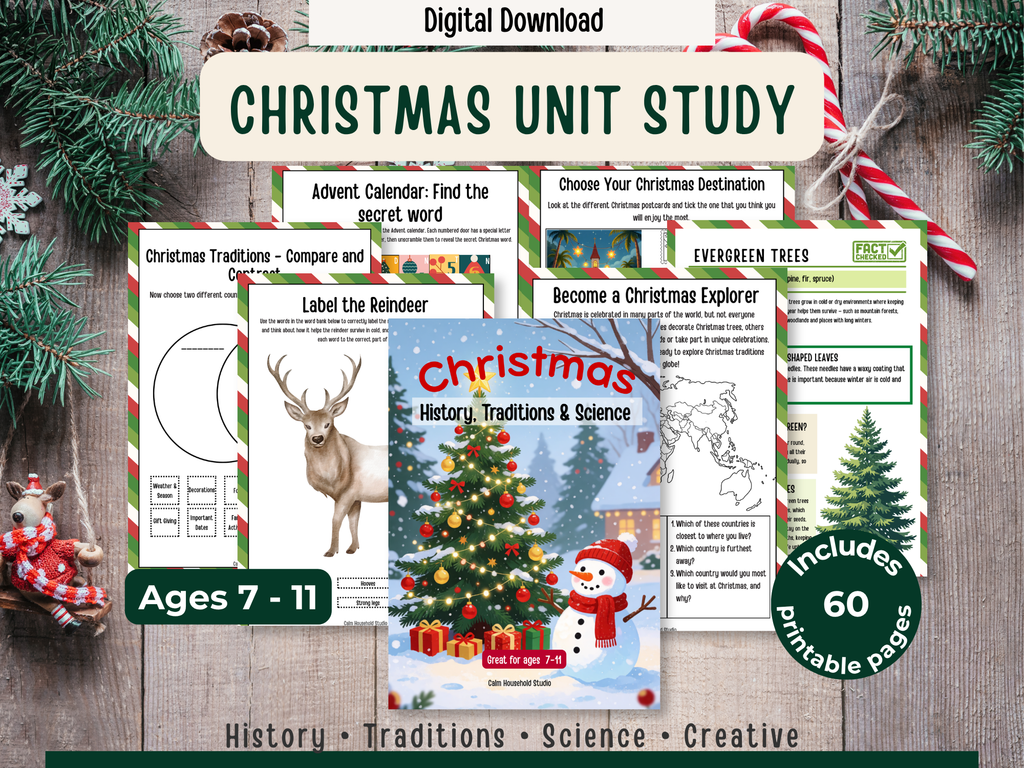
The unit study also includes a Christmas Explorer Certificate to celebrate completing the activities, along with colour and printer-friendly greyscale versions.
It’s ideal for families who want to add some educational activities to the Christmas holidays, as well as homeschoolers looking for a festive mini unit study.
Make Learning Part of the Christmas Fun
Christmas learning doesn’t have to mean sitting down with textbooks or completing worksheets every day.
Sometimes it’s as simple as discovering a new tradition, looking closely at a snowflake or working out how much a pretend shopping basket costs.
Choose an activity that interests your child, follow their questions and see where their curiosity takes you.
And if you’re looking for even more ways to keep the children busy in the run-up to Christmas, keep an eye out for our upcoming Christmas crafts, games and festive activities — including our 24 Days of Christmas Activities countdown.
- Brighten up your window with our Christmas Window Candles
- Learn how to make a DIY Angle Advent Calendar using toilet paper rolls
- Need an easy activity? Print our FREE Christmas Door Hanger templates and get colouring
There will be plenty of ideas to help you make the most of the festive season together!